Monday, March 6, 2017

Week 8 Growth Mindset

Image result for growth mindset
Growth Mindset (Flickr)

Without a doubt, one of my "fatal flaws" is the fact that I am very critical of my work. Looking back to my post from the beginning of the semester, I wrote about taking risks and growing in that mindset. While I do continue to believe in that and try to take risks whenever possible, I know that regardless of the outcome, I am critical of the work that I put in. I definitely think that this class is a way to gain some important insights by reading stories but also by realizing that I shouldn't always be critical of my work. I think that by being more positive about my work, I can continue to grow by improvement while taking risks. 

Week 8 Reflections

Image result for reading

When I enrolled for this course, I thought that I would just be reading Indian epics, stories, fables, etc. I was definitely excited at the chance to be able to read all these stories that I grew up learning. I did not expect to create my own stories or use the epics as inspiration for my portfolio project. But, I am enjoying every minute of it. The ability to read these stories but then reflect on them in various ways is so great because it allows me to connect to the stories and remember them better. Looking through my blog made me realize that I do have the ability to write creative stories, it just takes some inspiration. Specifically, I'm kind of proud of my portfolio because the idea is something I have always had, I just never sat down to do it. But, being able to research all of the interesting architectural sights and food of the different regions of India has been a lot of fun. I hope to use all that research when I go to India again in the future! When thinking of the second half of the semester, I definitely want to read a variety of stories. I love how all of the stories are somehow tied together and usually most of them have a moral behind them. But, I think another interesting facet of this class is being able to read the other student's posts because it not only shows their creativity but helps me gain some inspiration as well! I'm excited to see what the rest of the semester holds and can't wait to read more!

Reading Notes, Mahabaratha, Part D

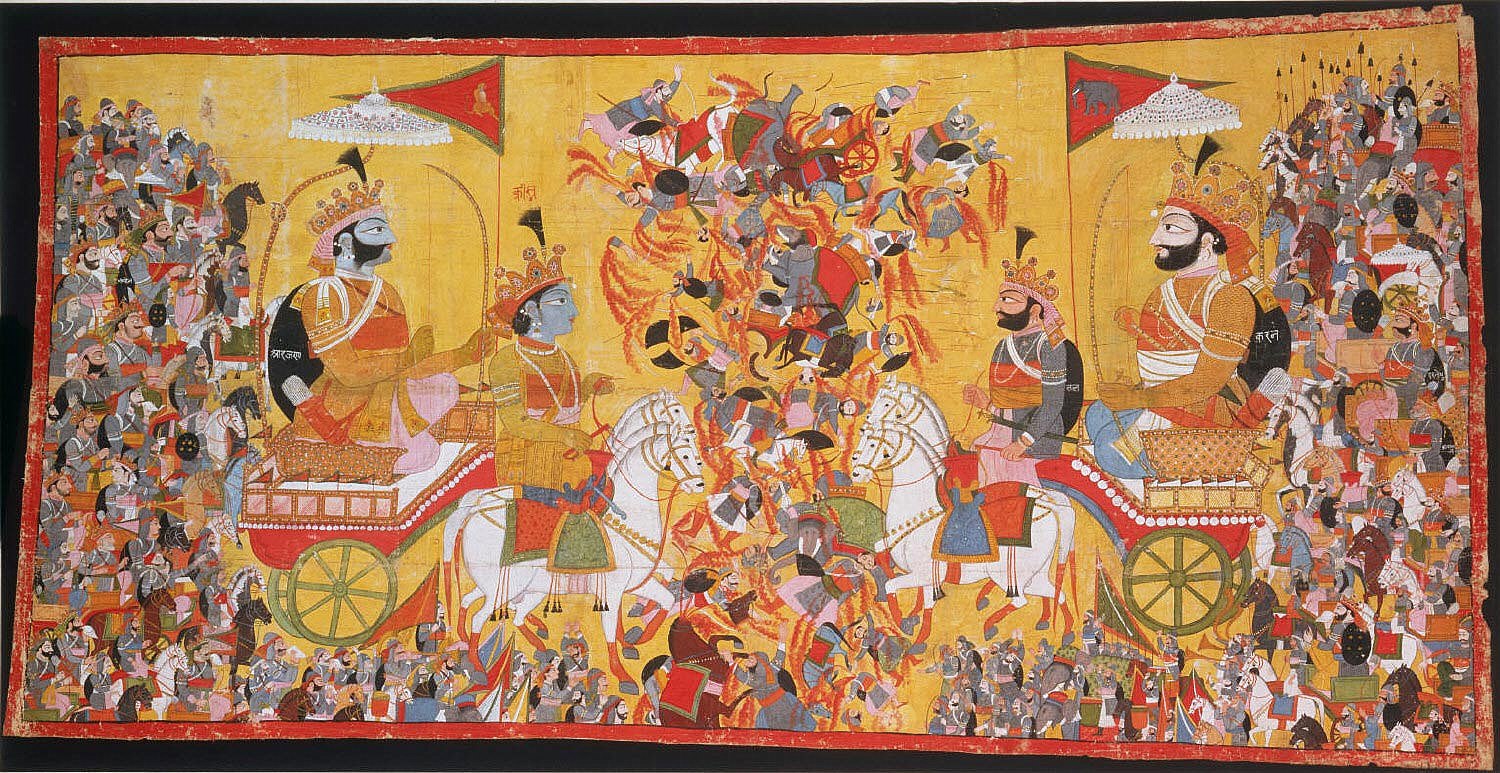
Image result for pandavas vs kauravas Pandavas vs. Kauravas (Wikipedia Commons)

When I think of the Mahabaratha, usually what comes to mind is the battle between the Pandavas and the Kauravas. I think the way the epic is narrated, the story builds to the eventual battle--which in a way is a battle of good vs. evil like in the Ramayana. While the battle is a crucial element to the Mahabaratha, I think the importance of it lies with the Bhagavad Gita and the internal struggles that each of the characters face. It appeals to the reader because of the parallels with every day life. Obviously, not everyone faces a violent battle to the extent of the Pandavas versus the Kauravas, but, everyone faces battles in life. These battles often take form in internal disputes, relationship troubles, issues with work/school, etc. The various lessons within the Mahabartha act as a guide to facing one's problems head-on and confronting them. While Veda Vyasa wrote this epic with an elaborate battle, depicted with intricate details, he was really appealing to the common man in describing how to confront these every day battles. However, in keeping with this theme of tackling issues, he also makes sure to address the troubles that come from it. Specifically, the Pandavas are obviously distraught at the fact that their cousins are now dead, by their hands. The Bhagavad Gita, for example, helps Arjuna to come to terms with the fact that he will have to fight his cousins. In an every day context, the Gita can be applied to literally anything. And that is the beauty of the Mahabaratha. 

Bibliography: Mahabaratha, R.K. Narayan, Reading Notes

Monday, February 20, 2017

Reading Notes: Mahabaratha, Part C


Image result for spy


I think the part of the Mahabaratha when the Pandavas have to be in hiding for a year is the most difficult part of the exile. While it is somewhat easy to go to another city or the forest and live life elsewhere, it is more difficult to live in hiding in the same city that you are from. If the Pandavas were discovered, they would have had to restart their entire exile from the beginning. I think if I were to create a story from this reading, I would make one in which someone has to live in hiding in the city that they are from; maybe a spy. However, I would make it to where the spy takes down a super-evil organization from the inside. This would be similar to how the Pandavas work for King Virata's kingdom during their year of hiding.

Bibliography: R.K Narayan, Mahabarata, Reading Notes

Reading Notes: Mahabaratha, Part B

Image result for dice game in mahabharata
Shakuni playing dice (Wikipedia Commons)

One of the common themes in many of the stories that I have read has been exile, especially in the Ramayana and the Mahabaratha. However, in both of these stories, the exiled are sent afar for a lengthy period of time, though they have really done nothing wrong. Rama and the Pandavas were honestly punished for the good morals that they possessed. However, foreshadowing the end of the Mahabaratha, good triumphs over evil, like in the Ramayana. I think the other major aspect of this story was the result of the first dice game when Draupadi's sari is unnecessarily pulled away. However, I think the important part of this section was to show the power of Draupadi's prayer to Krishna. As her sari is being pulled away, more and more cloth appears. This also signifies how the "good" are being punished when they have not done any wrong. Tying this back to a story, I think it would be interesting to write a story told in the present of someone that is sent to exile but is a valued member of society.


Bibliography: R.K Narayan, Mahabarata, Reading Notes

Friday, February 17, 2017

Reading Notes: Mahabaratha, Part A

Image result for pandavas
Pandavas (Wikipedia Commons)

I grew up learning about the Mahabaratha and its various tales. For this set of reading, I decided to read the RK Narayan version of the Mahabaratha. However, I quickly realized that there was a lot to the backstory that I did not know much about prior to the birth of the Pandavas and Kauravas. From reading this part, however, I think it would be interesting to write a story based off of a bystander looking onto the lives of the various members of the family. Without knowing exactly who the characters are, it can get a little confusing to understand both the major characters and even the lineage in the story. In that way, I think it would be interesting to write a story based on another person's perspective looking into the family. I think it would be especially interesting to have a story about Drona training both the Pandavas and the Kauravas or the Pandavas escaping from the fire.

Bibliography: R.K Narayan, Mahabarata, Reading Notes

Tech Tip: Google Timer

I think the timer is awesome and I wish I discovered this before. Usually, when I'm studying or working on a paper, I like to take breaks. But, often times, the breaks that are meant to be 10 minutes end up being 30 minutes long. I will definitely be using the timer more in the future!