Thursday, April 6, 2017

Week 11 Story Planning: The Three Friends

Image result for three friends

I definitely grew up hearing the story of Ganesha and Kartikeya racing all the time. While, as a child, the biggest thing that I got from that story was that parents are so vastly important, I do believe that the moral of the story is that the world can be viewed in a number of different perspectives. The way it is explained, however, makes a lot of sense. Some people view the world in a purely subjective, emotional, and intuitive fashion. Others view the world in an objective, rational, and logical way. However, I think that one of the strongest ways to view the world is by incorporating both elements to really gain an understanding of different perspectives. I think a great story for this would be to create a situation: a college decision, relationship, coping with a tragedy, etc. and then develop a story from two different perspectives and how each person would handle the situation. Specifically, I was thinking of a story in which three friends are attempting to confront a problem. One of the friends is very logical and thinks through things in an objective and rational way. One of the other friends is very subjective, emotional and intuitive in their thinking. Finally, the last friend is logical yet intuitive and objective, with a tinge of emotion when thinking. I think this would be an interesting story to write because it would require me to think out of the box. While I may think in one fashion, my perception of how another thinks would be different. 

I think these videos do a great job of describing some of the Indian stories in a way that everyone can understand them. In that way, DP discusses the stories and how Hindus view the world told through the lens of these stories. 

Wednesday, April 5, 2017

Reading Notes: Narayan's Secret

Image result for narayana
Wikipedia Commons (Narayana)

"Just as our world does not exist when we sleep, the whole universe does not exist when God is in deep slumber..."

I think this opening line from the video was pretty insightful. Obviously, people are unaware of their surroundings when they are asleep. Unless they are incredibly light sleepers, the likelihood of the average person knowing exactly what is happening around them while asleep is quite slim. I think it would be cool to write a story about someone that is asleep and having a vivid dream but then wakes up and lives their dream and has the ability to control it this time. It would feel like deja vu because of the dream but then the person would be able to control exactly what happens while awake. I think an interesting twist to add to this story would be that other people also have similar dreams so their destinies could be linked in a way. These intertwined stories would also be a way in which to incorporate mini-stories into the larger plotline.

Monday, April 3, 2017

Reading Notes: Ganesha's Secret Video

Image result for ganesha and kartikeya

I definitely grew up hearing the story of Ganesha and Kartikeya racing all the time. While, as a child, the biggest thing that I got from that story was that parents are so vastly important, I do believe that the moral of the story is that the world can be viewed in a number of different perspectives. The way it is explained, however, makes a lot of sense. Some people view the world in a purely subjective, emotional, and intuitive fashion. Others view the world in an objective, rational, and logical way. However, I think that one of the strongest ways to view the world is by incorporating both elements to really gain an understanding of different perspectives. I think a great story for this would be to create a situation: a college decision, relationship, coping with a tragedy, etc. and then develop a story from two different perspectives and how each person would handle the situation. 

I think these videos do a great job of describing some of the Indian stories in a way that everyone can understand them. In that way, DP discusses the stories and how Hindus view the world told through the lens of these stories. 

Week 10 Growth Mindset/Tech Tip Cheezburger

Caption this picture
LOLBuilder (Dog Winking)

While I strongly believe that positivity is an important trait to have, it can often be difficult to be positive. This week, I thought that it would be fun to incorporate the Tech Tip with Growth Mindset to create an inspirational post. Often times, people get so caught up in their lives and forget that it is important to grow, to be positive, and just take some time to smile. This is especially important when thinking of growth beyond school. When we are in school, we essentially have a system guiding us through the process and there is usually help provided if necessary. But, I think once people start thinking of the future, they become scared. And that is exactly where positivity comes into play. It is easy to get caught up in one's life and forget that smiling is so incredibly important. I think that the power of the growth mindset, for me, comes from the fact that staying positive and knowing that it will be okay is so very important. 

Monday, March 6, 2017

Week 8 Growth Mindset

Image result for growth mindset
Growth Mindset (Flickr)

Without a doubt, one of my "fatal flaws" is the fact that I am very critical of my work. Looking back to my post from the beginning of the semester, I wrote about taking risks and growing in that mindset. While I do continue to believe in that and try to take risks whenever possible, I know that regardless of the outcome, I am critical of the work that I put in. I definitely think that this class is a way to gain some important insights by reading stories but also by realizing that I shouldn't always be critical of my work. I think that by being more positive about my work, I can continue to grow by improvement while taking risks. 

Week 8 Reflections

Image result for reading

When I enrolled for this course, I thought that I would just be reading Indian epics, stories, fables, etc. I was definitely excited at the chance to be able to read all these stories that I grew up learning. I did not expect to create my own stories or use the epics as inspiration for my portfolio project. But, I am enjoying every minute of it. The ability to read these stories but then reflect on them in various ways is so great because it allows me to connect to the stories and remember them better. Looking through my blog made me realize that I do have the ability to write creative stories, it just takes some inspiration. Specifically, I'm kind of proud of my portfolio because the idea is something I have always had, I just never sat down to do it. But, being able to research all of the interesting architectural sights and food of the different regions of India has been a lot of fun. I hope to use all that research when I go to India again in the future! When thinking of the second half of the semester, I definitely want to read a variety of stories. I love how all of the stories are somehow tied together and usually most of them have a moral behind them. But, I think another interesting facet of this class is being able to read the other student's posts because it not only shows their creativity but helps me gain some inspiration as well! I'm excited to see what the rest of the semester holds and can't wait to read more!

Reading Notes, Mahabaratha, Part D

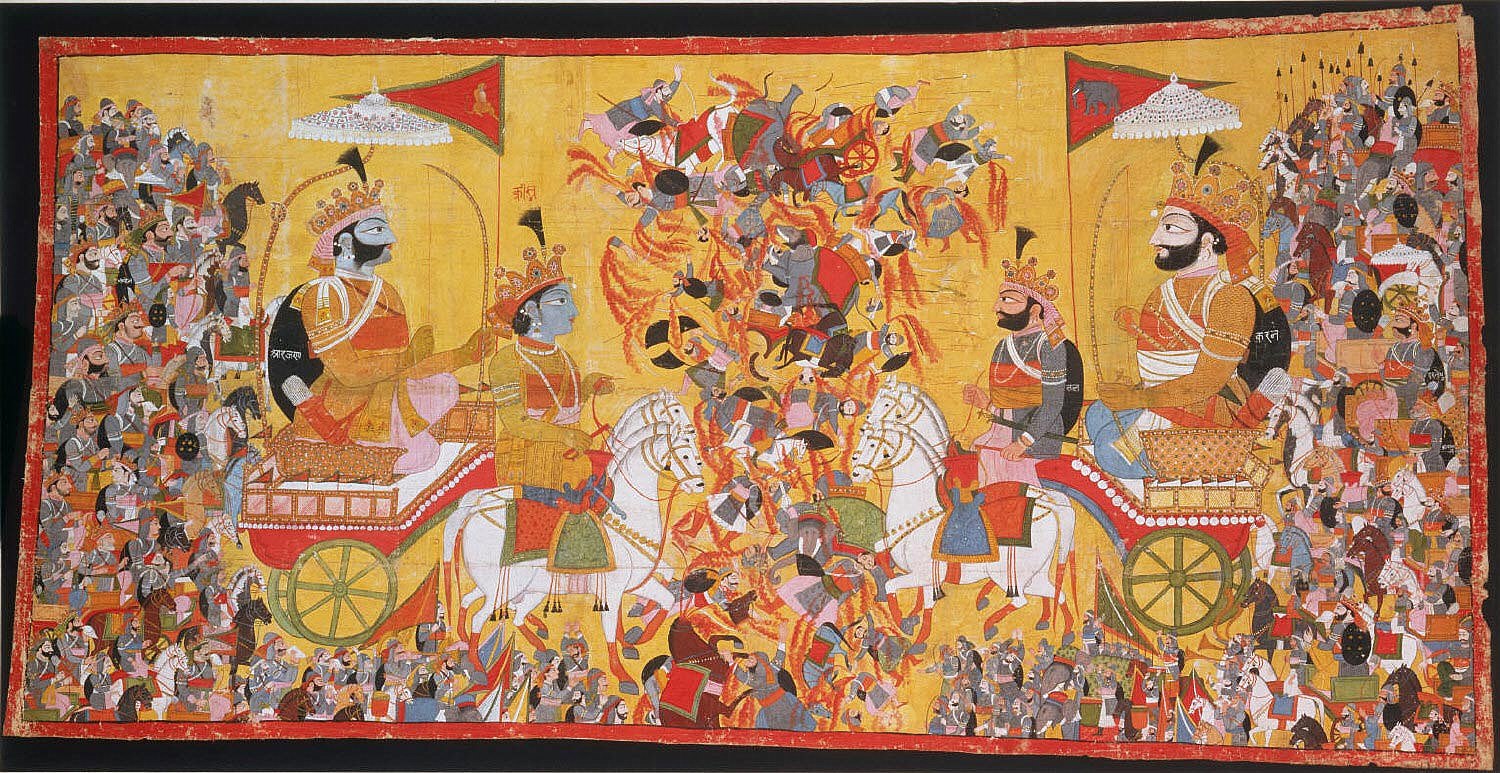
Image result for pandavas vs kauravas Pandavas vs. Kauravas (Wikipedia Commons)

When I think of the Mahabaratha, usually what comes to mind is the battle between the Pandavas and the Kauravas. I think the way the epic is narrated, the story builds to the eventual battle--which in a way is a battle of good vs. evil like in the Ramayana. While the battle is a crucial element to the Mahabaratha, I think the importance of it lies with the Bhagavad Gita and the internal struggles that each of the characters face. It appeals to the reader because of the parallels with every day life. Obviously, not everyone faces a violent battle to the extent of the Pandavas versus the Kauravas, but, everyone faces battles in life. These battles often take form in internal disputes, relationship troubles, issues with work/school, etc. The various lessons within the Mahabartha act as a guide to facing one's problems head-on and confronting them. While Veda Vyasa wrote this epic with an elaborate battle, depicted with intricate details, he was really appealing to the common man in describing how to confront these every day battles. However, in keeping with this theme of tackling issues, he also makes sure to address the troubles that come from it. Specifically, the Pandavas are obviously distraught at the fact that their cousins are now dead, by their hands. The Bhagavad Gita, for example, helps Arjuna to come to terms with the fact that he will have to fight his cousins. In an every day context, the Gita can be applied to literally anything. And that is the beauty of the Mahabaratha. 

Bibliography: Mahabaratha, R.K. Narayan, Reading Notes